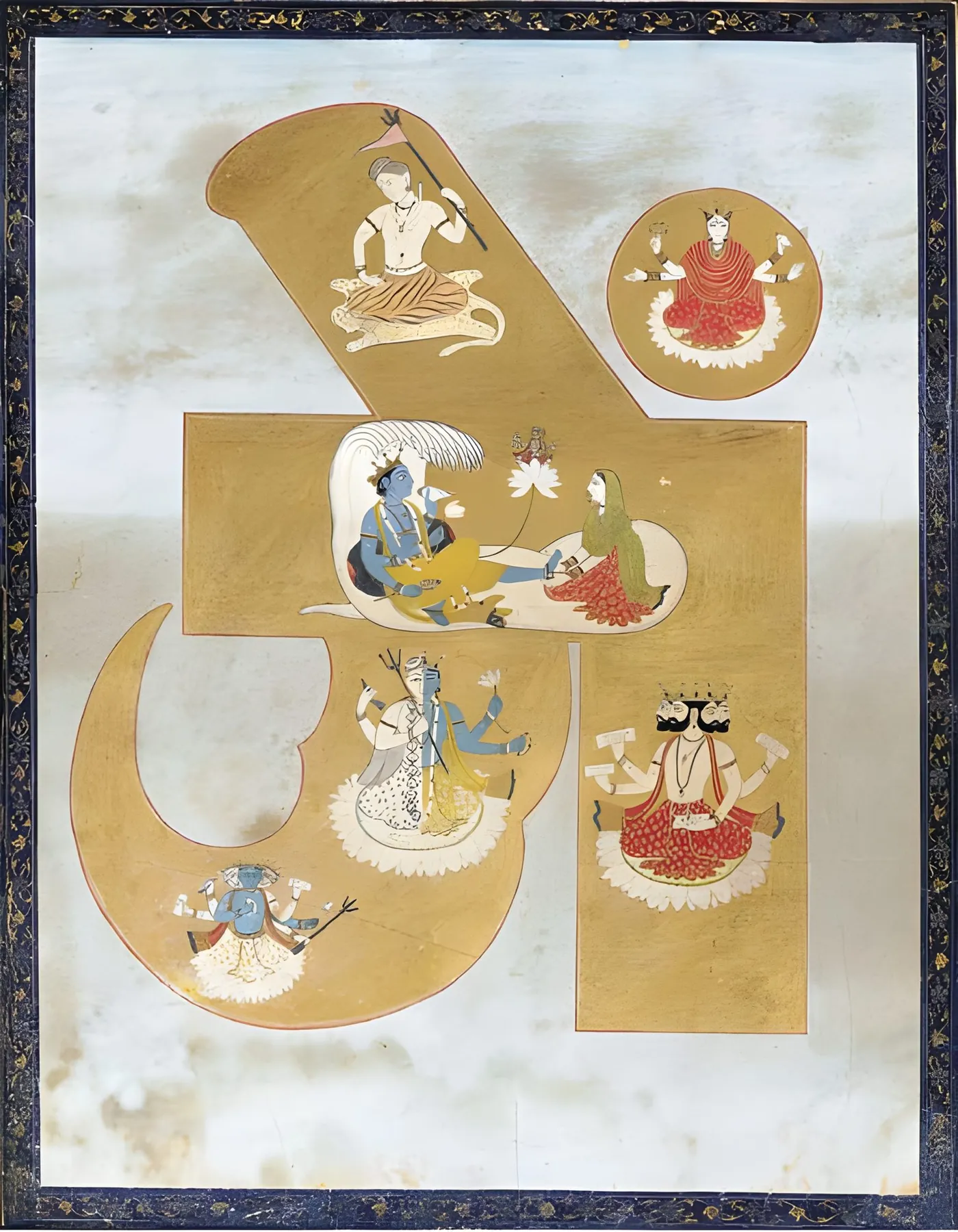
A Pahari painting of an Om containing deities. Pahari, c. 1780–1800.

The Living Mystics

मो को कहाँ ढूँढ़ो बन्दे

Where dost thou seek Me? Lo! I am beside thee.

Kabir · tr. Rabindranath Tagore, 1915

Enter

Tonight's verse

Ṛgveda 7.59.12

त्र्यम्बकं यजामहे सुगन्धिं पुष्टिवर्धनम् ।

उर्वारुकमिव बन्धनान्मृत्योर्मुक्षीय मामृतात् ॥

tryambakaṃ yajāmahe sugandhiṃ puṣṭivardhanam |
urvārukam iva bandhanān mṛtyor mukṣīya māmṛtāt ||

Tryambaka we worship, sweet augmenter of prosperity.

As from its stem the cucumber, so may I be released from death, not reft of immortality.

In plain words: As a ripe fruit slips free from its vine by itself, may I come free from death, and never from the deathless.

Source

Root text: Ṛgveda, Book 7, Hymn 59, verse 12 (Sanskrit as on Sanskrit Wikisource, without prepended oṃ). English: Ralph T. H. Griffith, The Hymns of the Rigveda, 2nd ed., 1896. Read the whole hymn ↗ · The Sanskrit ↗

Root textTransliterationTranslation · 1896

From Shiva Lok →

Bhagavad Gītā 2.47

कर्मण्येवाधिकारस्ते मा फलेषु कदाचन ।

मा कर्मफलहेतुर्भूर्मा ते सङ्गोऽस्त्वकर्मणि ॥

karmaṇy evādhikāras te mā phaleṣu kadācana |
mā karma-phala-hetur bhūr mā te saṅgo 'stv akarmaṇi ||

Thy business is with the action only, never with its fruits;

so let not the fruit of action be thy motive, nor be thou to inaction attached.

सरल अर्थ: तुम्हारा अधिकार कर्म पर है, फल पर नहीं। फल के लिए कर्म मत करो, और कर्म छोड़ो भी मत।

In plain words: Your part is the action alone, never its reward — do not work for the outcome, yet do not turn away from acting.

Source

Root text: Bhagavad Gītā, chapter 2, verse 47. Sanskrit and English as printed in Annie Besant, The Bhagavad-Gītā, or The Lord's Song, 4th edition (the 1922 printing on Wikisource), Discourse 2, p. 24. Read the whole discourse ↗

Root textTransliterationTranslation · Besant

From Krishna Lok →

Rāmcaritmānas · Bālkāṇḍ

मङ्गल-भवन अमङ्गल-हारी ।

द्रवउ सो दसरथ अजिर-बिहारी ॥

maṅgala-bhavana amaṅgala-hārī |
dravau so dasaratha ajira-bihārī ||

Come to me, O home of bliss and bane of woe,

as when thou usedst to sport in Dasarath's courtyard.

सरल अर्थ: मंगल के घर और अमंगल को हरने वाले, जो दशरथ के आँगन में खेलते थे, वे राम मुझ पर कृपा करें।

In plain words: Rāma, home of all good and remover of all harm, the child who played in Daśaratha's courtyard — be kind to me.

Source

Root text: Tulsīdās, Rāmcaritmānas, Bālkāṇḍ, in Awadhi (as on Hindi Wikisource). English: F. S. Growse, The Rámáyana of Tulsí Dás, 6th edition (Allahabad, 1914), Book I, Chaupái 112, p. 74. Growse's translation ↗ · The Awadhi ↗

Root textTransliterationTranslation · 1914

From Devotion Lok →

Dhammapada 1

Manopubbaṅgamā dhammā, manoseṭṭhā manomayā;

Manasā ce paduṭṭhena, bhāsati vā karoti vā;

Tato naṁ dukkhamanveti, cakkaṁva vahato padaṁ.

All that we are is the result of what we have thought: it is founded on our thoughts, it is made up of our thoughts.

If a man speaks or acts with an evil thought, pain follows him, as the wheel follows the foot of the ox that draws the carriage.

सरल अर्थ: मन सबसे पहले आता है। दूषित मन से बोलो या करो, तो दुःख पीछे-पीछे आता है, जैसे गाड़ी का पहिया बैल के पैरों के पीछे।

In plain words: The mind goes first — speak or act from a clouded mind and suffering follows you, as the cart wheel follows the foot of the ox.

Source

Root text: Dhammapada, verse 1, in Pali (Mahāsaṅgīti edition, via SuttaCentral). English: F. Max Müller, The Dhammapada, Sacred Books of the East vol. X (Oxford, 1881). Müller's translation ↗ · The Pali ↗

Root text · PaliTranslation · 1881

From Buddha Lok →

Matsuo Bashō · 1686

古池や蛙飛びこむ水の音

furu ike ya
kawazu tobikomu
mizu no oto

The old pond, aye! and the sound of a frog leaping into the water.

सरल अर्थ: पुराना तालाब। मेंढक कूदा। पानी की आवाज़।

In plain words: An old pond, a frog leaping in, and the sound of water.

Source

Root text: Matsuo Bashō's hokku of 1686. English: Basil Hall Chamberlain, “Bashō and the Japanese Poetical Epigram,” Transactions of the Asiatic Society of Japan, vol. XXX, part 2 (Tokyo, 1902), p. 279. Read Chamberlain's essay ↗

Root textTransliterationTranslation · 1902

From Zen Lok →

Ommen, 3 August 1929

I maintain that Truth is a pathless land, and you cannot approach it by any path whatsoever, by any religion, by any sect.

Source

J. Krishnamurti, from the talk dissolving the Order of the Star, Ommen, the Netherlands, 3 August 1929. A short quotation; the words remain © Krishnamurti Foundation Trust. Read the whole talk on the Foundation's site ↗

Quotation© Krishnamurti Foundation Trust

From Krishnamurti Lok →

Lallā · saying 94

My teacher spake to me but one precept.

He said unto me, ‘from without enter thou the inmost part’.

That to me became a rule and a precept,

And therefore naked began I to dance.

In plain words: One instruction: from the outside, enter the innermost. She followed it until nothing was left to hide behind.

Source

Lallā (Lal Dĕd) of Kashmir. English: Sir George Grierson and Lionel D. Barnett, Lallā-Vākyāni, or the Wise Sayings of Lal Dĕd (London: Royal Asiatic Society, 1920), no. 94, p. 107. The Kashmiri is printed in the same book; it is not shown here. The 1920 book ↗

Translation · 1920

From Shiva Lok →

Bhagavad Gītā 6.19

यथा दीपो निवातस्थो नेङ्गते सोपमा स्मृता ।

योगिनो यतचित्तस्य युञ्जतो योगमात्मनः ॥

yathā dīpo nivāta-stho neṅgate sopamā smṛtā |
yogino yata-cittasya yuñjato yogam ātmanaḥ ||

As a lamp in a windless place flickereth not, to such is likened the Yogî of subdued thought, absorbed in the yoga of the Self.

In plain words: A lamp where no wind blows does not flicker. So is a mind gathered into the Self.

Source

Root text: Bhagavad Gītā, chapter 6, verse 19. Sanskrit and English as printed in Annie Besant, The Bhagavad-Gītā, or The Lord's Song, 4th edition (the 1922 printing on Wikisource), Discourse 6. Read the whole discourse ↗

Root textTransliterationTranslation · Besant

From Krishna Lok →

Rāmcaritmānas · Bālkāṇḍ, dohā

राम-नाममनि-दीप धरु, जीह देहरी-द्वार ।

तुलसी भीतर बाहरहुँ, जौं चाहसि उँजियार ॥

rāma-nāmamani-dīpa dharu, jīha deharī-dvāra |
tulasī bhītara bāharahũ, jauṃ cāhasi ũjiyāra ||

Place the name of Ráma as a jewelled lamp at the door of your lips

and there will be light, as you will, both inside and out.

In plain words: Set the Name on your tongue like a lamp in a doorway, and it lights the inside and the outside at once.

Source

Tulsīdās, Rāmcaritmānas, Bālkāṇḍ (dohā 21 in the 1925 Awadhi edition on Hindi Wikisource). English: F. S. Growse, The Rámáyana of Tulsi Dás, 6th edition (Allahabad: Ram Narain Lal, 1914), Dohá 25, pp. 19–20. Growse's translation ↗ · The Awadhi ↗

Root textTransliterationTranslation · 1914

From Devotion Lok →

Dhammapada 5

Na hi verena verāni, sammantīdha kudācanaṁ;

Averena ca sammanti, esa dhammo sanantano.

For hatred does not cease by hatred at any time: hatred ceases by love, this is an old rule.

In plain words: Hate has never once ended hate. Only love ends it. This is an old law.

Source

Root text: Dhammapada, verse 5, Pali (Mahāsaṅgīti edition, SuttaCentral). English: F. Max Müller, The Dhammapada, Sacred Books of the East vol. X (Oxford, 1881). Müller's translation ↗ · The Pali ↗

Root text · PaliTranslation · 1881

From Buddha Lok →

Layman P'ang (Ho-koji)

How wondrously supernatural,

And how miraculous, this!

I draw water, and I carry fuel!

In plain words: The wonder is not somewhere else. It is in carrying water and firewood.

Source

English: D. T. Suzuki, Essays in Zen Buddhism (First Series) (London: Luzac and Company, 1927), Essay VII, The Meditation Hall. The Chinese is not shown here. Read Suzuki's essays (1927) ↗

Translation · 1927

From Zen Lok →

Ommen, 3 August 1929

The moment you follow someone you cease to follow Truth.

Source

J. Krishnamurti, from the talk dissolving the Order of the Star, Ommen, the Netherlands, 3 August 1929. A short quotation; the words remain © Krishnamurti Foundation Trust. Read the whole talk on the Foundation's site ↗

Quotation© Krishnamurti Foundation Trust

From Krishnamurti Lok →

Lallā · saying 48

I, Lalla, wearied myself seeking for Him and searching.

I laboured and strove even beyond my strength.

I began to look for Him, and, lo, I saw that bolts were on His door,

And even in me, as I was, did longing for Him become fixed; and there, where I was, I gazed upon Him.

In plain words: The outer door was bolted. When the searching stopped, what she sought was already standing where she stood.

Source

Lallā (Lal Dĕd) of Kashmir. English: Sir George Grierson and Lionel D. Barnett, Lallā-Vākyāni, or the Wise Sayings of Lal Dĕd (London: Royal Asiatic Society, 1920), no. 48, p. 67. The Kashmiri is printed in the same book; it is not shown here. The 1920 book ↗

Translation · 1920

From Shiva Lok →

Bhagavad Gītā 2.20

न जायते म्रियते वा कदाचिन्नायं भूत्वा भविता वा न भूयः ।

अजो नित्यः शाश्वतोऽयं पुराणो न हन्यते हन्यमाने शरीरे ॥

na jāyate mriyate vā kadācin nāyaṃ bhūtvā bhavitā vā na bhūyaḥ |
ajo nityaḥ śāśvato 'yaṃ purāṇo na hanyate hanyamāne śarīre ||

He is not born, nor doth he die; nor having been, ceaseth he any more to be;

unborn, perpetual, eternal and ancient, he is not slain when the body is slaughtered.

In plain words: What you truly are was never born and never dies. It is not killed when the body is killed.

Source

Root text: Bhagavad Gītā, chapter 2, verse 20. Sanskrit and English as printed in Annie Besant, The Bhagavad-Gītā, or The Lord's Song, 4th edition (the 1922 printing on Wikisource), Discourse 2. Read the whole discourse ↗

Root textTransliterationTranslation · Besant

From Krishna Lok →

Rāmcaritmānas · Bālkāṇḍ, chaupāī

सीय-राम-मय सब जग जानी ।

करउँ प्रनाम जोरि जुग पानी ॥

sīya-rāma-maya saba jaga jānī |
karaũ pranāma jori juga pānī ||

With clasped hand I perform an act of adoration,

recognizing the whole world as pervaded by the spirit of Síta and Ráma.

In plain words: Seeing the whole world as filled with Sītā and Rāma, he bows to all of it with joined hands.

Source

Tulsīdās, Rāmcaritmānas, Bālkāṇḍ (the 1925 Awadhi edition on Hindi Wikisource). English: F. S. Growse, The Rámáyana of Tulsi Dás, 6th edition (Allahabad: Ram Narain Lal, 1914), Chaupái 8, p. 8. Growse's translation ↗ · The Awadhi ↗

Root textTransliterationTranslation · 1914

From Devotion Lok →

Dhammapada 103

Yo sahassaṁ sahassena, saṅgāme mānuse jine;

Ekañca jeyyamattānaṁ, sa ve saṅgāmajuttamo.

If one man conquer in battle a thousand times thousand men, and if another conquer himself, he is the greatest of conquerors.

In plain words: To win against a million men is less than to win against yourself.

Source

Root text: Dhammapada, verse 103, Pali (Mahāsaṅgīti edition, SuttaCentral). English: F. Max Müller, The Dhammapada, Sacred Books of the East vol. X (Oxford, 1881). Müller's translation ↗ · The Pali ↗

Root text · PaliTranslation · 1881

From Buddha Lok →

Seigen Ishin (Ch'ing-yüan)

Before a man studies Zen, to him mountains are mountains and waters are waters;

after he gets an insight into the truth of Zen through the instruction of a good master, mountains to him are not mountains and waters are not waters;

but after this when he really attains to the abode of rest, mountains are once more mountains and waters are waters.

In plain words: First the world looks ordinary. Then it stops looking ordinary. In the end it is ordinary again, and seen clearly.

Source

English: D. T. Suzuki, Essays in Zen Buddhism (First Series) (London: Luzac and Company, 1927), Essay I, Introduction. The Chinese is not shown here. Read Suzuki's essays (1927) ↗

Translation · 1927

From Zen Lok →

Ommen, 3 August 1929

My only concern is to set man absolutely, unconditionally free.

Source

J. Krishnamurti, from the talk dissolving the Order of the Star, Ommen, the Netherlands, 3 August 1929. A short quotation; the words remain © Krishnamurti Foundation Trust. Read the whole talk on the Foundation's site ↗

Quotation© Krishnamurti Foundation Trust

From Krishnamurti Lok →

Devī Māhātmya · Mārkaṇḍeya Purāṇa 85.13

या देवी सर्वभूतेषु चेतनेत्यभिधीयते ।

नमस्तस्यै नमस्तस्यै नमस्तस्यै नमो नमः ॥

yā devī sarva-bhūteṣu cetanety abhidhīyate |
namas tasyai namas tasyai namas tasyai namo namaḥ ||

To the goddess who among all created beings

Bears the name Consciousness,

Reverence to her, yea reverence to her!

Reverence to her, reverence, yea reverence!

In plain words: She is named as the awareness in every living being. The hymn only bows, and bows again.

Source

Root text: Mārkaṇḍeya Purāṇa, Canto LXXXV (Devī Māhātmya, ch. 5), verse 13 (Sanskrit as on Sanskrit Wikisource). English: F. Eden Pargiter, The Markandeya Purana, Bibliotheca Indica (Calcutta: Asiatic Society, 1904), Canto LXXXV. Pargiter’s 1904 edition ↗ · The Sanskrit ↗

Root textTransliterationTranslation · 1904

From Shiva Lok →

Bhagavad Gītā 9.26

पत्रं पुष्पं फलं तोयं यो मे भक्त्या प्रयच्छति ।

तदहं भक्त्युपहृतमश्नामि प्रयतात्मनः ॥

patraṃ puṣpaṃ phalaṃ toyaṃ yo me bhaktyā prayacchati |
tad ahaṃ bhakty-upahṛtam aśnāmi prayatātmanaḥ ||

He who offereth to Me with devotion a leaf, a flower, a fruit, water, that I accept from the striving self, offered as it is with devotion.

In plain words: A leaf, a flower, a fruit, a little water. Given with love, it is enough.

Source

Root text: Bhagavad Gītā, chapter 9, verse 26. Sanskrit and English as printed in Annie Besant, The Bhagavad-Gītā, or The Lord's Song, 4th edition (the 1922 printing on Wikisource), Discourse 9. Read the whole discourse ↗

Root textTransliterationTranslation · Besant

From Krishna Lok →

Nārada Bhakti Sūtra 2–3

सा त्वस्मिन् परमप्रेमरूपा ॥ २ ॥

अमृतस्वरूपा च ॥ ३ ॥

sā tv asmin parama-prema-rūpā ||
amṛta-svarūpā ca ||

Its nature is extreme devotion (prema-rûpa) to some one.

Love is immortal (amṛta-rûpa).

In plain words: Devotion is the highest love, given to one. And that love does not die.

Source

Root text: Nārada Bhakti Sūtra, sūtras 2–3 (Sanskrit as on Sanskrit Wikisource). English: E. T. Sturdy, Nârada Sûtra: An Inquiry into Love (London: Longmans, Green, 1896), the opening page of the sūtras. Sturdy's translation ↗ · The Sanskrit ↗

Root textTransliterationTranslation · 1896

From Devotion Lok →

Dhammapada 160

Attā hi attano nātho, ko hi nātho paro siyā;

Attanā hi sudantena, nāthaṁ labhati dullabhaṁ.

Self is the lord of self, who else could be the lord?

With self well subdued, a man finds a lord such as few can find.

In plain words: No one else can be your master. Tame yourself, and you find the master few ever find.

Source

Root text: Dhammapada, verse 160, Pali (Mahāsaṅgīti edition, SuttaCentral). English: F. Max Müller, The Dhammapada, Sacred Books of the East vol. X (Oxford, 1881). Müller's translation ↗ · The Pali ↗

Root text · PaliTranslation · 1881

From Buddha Lok →

Hui-neng, the sixth patriarch

The Bodhi is not like the tree,

The mirror bright is nowhere shining;

As there is nothing from the first,

Where can the dust itself collect?

In plain words: There was never a mirror to polish, so where could dust settle?

Source

English: D. T. Suzuki, Essays in Zen Buddhism (First Series) (London: Luzac and Company, 1927), Essay IV. The Chinese is not shown here. Read Suzuki's essays (1927) ↗

Translation · 1927

From Zen Lok →

Śrī Rudram · Taittirīya Saṃhitā 4.5.8

नमः शिवाय च शिवतराय च

namaḥ śivāya ca śivatarāya ca

Homage to the auspicious, and to the more auspicious,

In plain words: The Vedic seed of the five syllables — not a request, only a quiet bow to what is auspicious.

Source

Root text: Krishna Yajurveda, Taittirīya Saṃhitā 4.5.8, item l (the eighth anuvāka of the Śrī Rudram, where namaḥ śivāya appears). English: Arthur Berriedale Keith, The Veda of the Black Yajus School entitled Taittiriya Sanhita, Part 2, Harvard Oriental Series, Vol. 19 (Cambridge, Mass.: Harvard University Press, 1914), p. 359. Keith’s 1914 volume ↗ · The Sanskrit ↗

Root textTransliterationTranslation · 1914

From Shiva Lok →

Bhagavad Gītā 10.20

अहमात्मा गुडाकेश सर्वभूताशयस्थितः ।

अहमादिश्च मध्यं च भूतानामन्त एव च ॥

aham ātmā guḍākeśa sarva-bhūtāśaya-sthitaḥ |
aham ādiś ca madhyaṃ ca bhūtānām anta eva ca ||

I, O Gudakesha, am the Self, seated in the heart of all beings;

I am the beginning, the middle, and also the end of all beings.

In plain words: Krishna says: I am the Self in the heart of every being, its beginning, its middle and its end.

Source

Root text: Bhagavad Gītā, chapter 10, verse 20. Sanskrit and English as printed in Annie Besant, The Bhagavad-Gītā, or The Lord's Song, 4th edition (the 1922 printing on Wikisource), Discourse 10. Read the whole discourse ↗

Root textTransliterationTranslation · Besant

From Krishna Lok →

Mahāparinibbāna Sutta

Tasmātihānanda, attadīpā viharatha attasaraṇā anaññasaraṇā,

dhammadīpā dhammasaraṇā anaññasaraṇā.

Therefore, O Ânanda, be ye lamps unto yourselves. Be ye a refuge to yourselves. Betake yourselves to no external refuge.

Hold fast to the truth as a lamp. Hold fast as a refuge to the truth. Look not for refuge to any one besides yourselves.

In plain words: Near the end, the Buddha tells Ānanda: be your own lamp and your own refuge. Let the truth be your lamp, and look for no other.

Source

Root text: Mahāparinibbāna Sutta (Dīgha Nikāya 16), Pali (Mahāsaṅgīti edition, SuttaCentral, DN 16 section 2.26). English: T. W. Rhys Davids, Buddhist Suttas, Sacred Books of the East vol. XI (Oxford, 1881), chapter II, § 33, p. 38. Rhys Davids' translation ↗ · The Pali ↗

Root text · PaliTranslation · 1881

From Buddha Lok →

Hui-neng, to the monk Ming

Think not of good, think not of evil, but see what at this moment thy own original face doth look like, which thou hadst even prior to thy own birth.

In plain words: Drop good and bad for a moment and look: what were you before you were born?

Source

English: D. T. Suzuki, Essays in Zen Buddhism (First Series) (London: Luzac and Company, 1927), Essay IV. The Chinese is not shown here. Read Suzuki's essays (1927) ↗

Translation · 1927

From Zen Lok →

Śiva Sūtras · 1.1

चैतन्यमात्मा ॥ १ ॥

caitanyam ātmā || 1 ||

Consciousness is the Self.

In plain words: Not that you have consciousness. What is reading this line is what you are.

Source

Root text: Vasugupta, Śiva Sūtras, Section 1 (Śāmbhavopāya), sūtra 1, as printed in Kṣemarāja’s Śiva Sūtra Vimarśinī, Kashmir Series of Texts and Studies, Vol. I (Srinagar, 1911). English: Living Mystics gloss from the Sanskrit (no public-domain English translation exists). The 1911 Kashmir Series edition ↗

Root text · 1911TransliterationLiving Mystics gloss

From Shiva Lok →

Questions

Five questions one seeker could not put down. They may be yours.

Sit with five questions →

The Universal Walk

A slow walk under the stars. At every gate, one line from the old texts.

Begin the Walk
The six worlds
  1. शिव लोकShiva Lok
  2. कृष्ण लोकKrishna Lok
  3. भक्ति लोकDevotion Lok
  4. बुद्ध लोकBuddha Lok
  5. ज़ेन लोकZen Lok
  6. कृष्णमूर्ति लोकKrishnamurti Lok
  7. यात्राThe Universal Walk
Look closer