प्रश्न

Questions

Five questions that rose out of one quiet night, each growing out of the one before it. No answers are printed here — only an older mirror, and a minute of silence.

Asked by the channel’s founder, Tushar Siwal, in November 2026. The verses beside them are checked public-domain editions — mirrors to sit with, never conclusions.

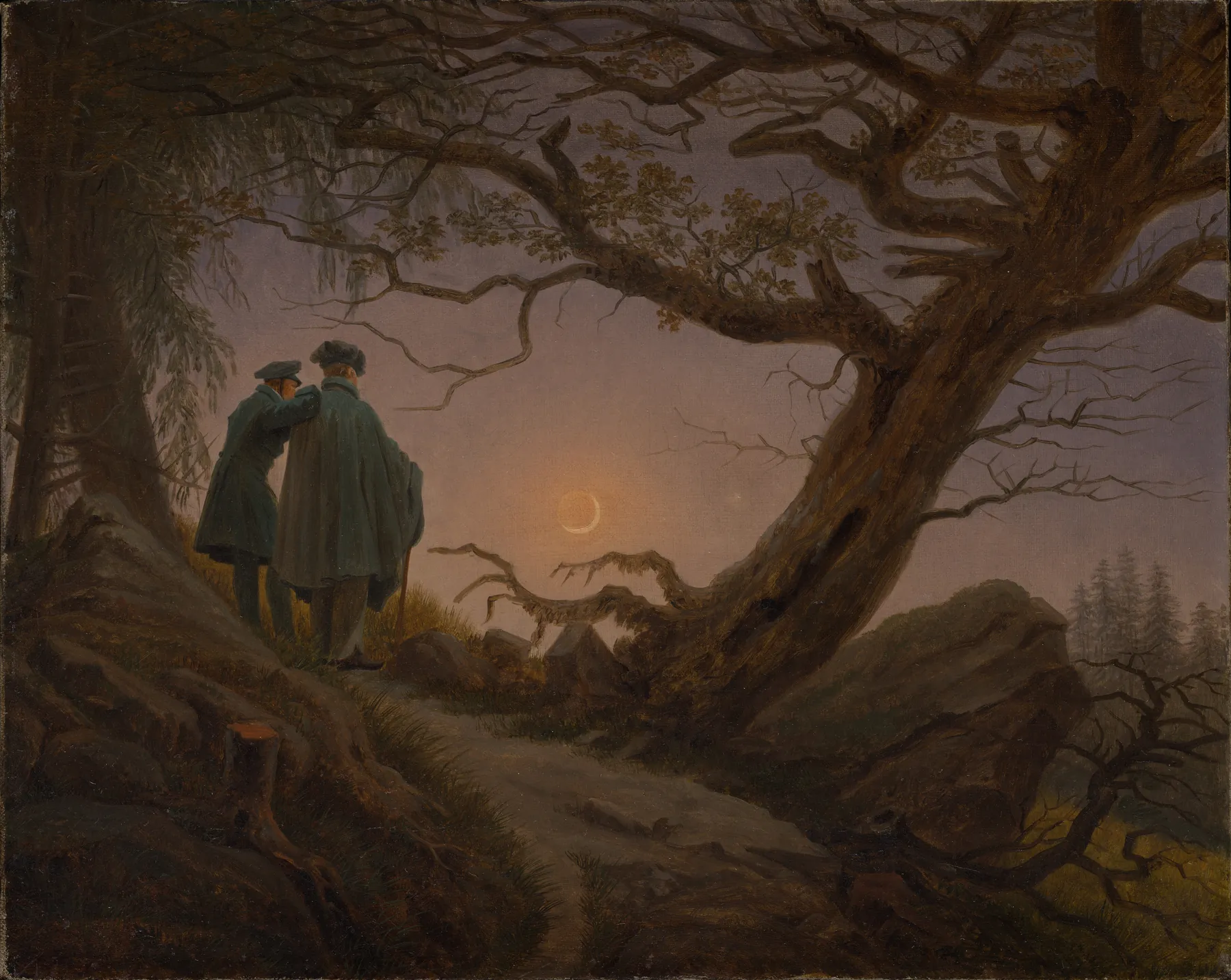
Two Men Contemplating the Moon. Caspar David Friedrich, ca. 1825–30.
Two Men Contemplating the Moon, ca. 1825–30
१ · Question 1 of 5

Who is the knower — and why does it slip away the moment I look for it?

Looking for a noun, when it is a verb. Every time you try to catch the one who knows, you only catch another thought.

Unseen, but seeing; unheard, but hearing; unperceived, but perceiving; unknown, but knowing.

There is no other seer but he, there is no other hearer but he, there is no other perceiver but he, there is no other knower but he.

This is thy Self, the ruler within, the immortal.

Bṛhadāraṇyaka Upaniṣad 3.7.23. English: F. Max Müller, The Upanishads, Part II, Sacred Books of the East, Vol. 15 (Oxford: Clarendon Press, 1884). Müller’s 1884 edition ↗

Close your eyes for one minute. Notice a sound in the room, then turn gently toward what is hearing it — without picturing anything.

२ · Question 2 of 5

If life is simply happening, why does the mind always want activity?

What is the difference between necessary action and restless activity — and why can the mind hardly bear an empty minute?

Some, though they be sound asleep, are yet awake;

On others, though they be awake, hath slumber fallen.

Some, though they bathe in sacred pools, are yet unclean;

Others, though they be full of household cares, are yet free from action.

Lallā (Lal Dĕd) of Kashmir. English: Sir George Grierson and Lionel D. Barnett, Lallā-Vākyāni, or the Wise Sayings of Lal Dĕd (London: Royal Asiatic Society, 1920), no. 33, p. 53. The 1920 book ↗

Sit with both hands empty for sixty seconds. Notice the first impulse to reach, check or plan — and leave it unfollowed.

३ · Question 3 of 5

Is the mind a thing at all — or only a process?

Not an object stored behind the eyes, only a continuous movement. When the movement pauses, what remains?

योगश्चित्तवृत्तिनिरोधः ॥ १.२ ॥

तदा द्रष्टुः स्वरूपेऽवस्थानम् ॥ १.३ ॥

yogaś citta-vṛtti-nirodhaḥ || 1.2 ||
tadā draṣṭuḥ svarūpe 'vasthānam || 1.3 ||

Yoga is the restriction of the fluctuations of mind-stuff.

Then the Seer [that is, the Self,] abides in himself.

Root text: Patañjali, Yoga Sūtra 1.2–1.3 (Sanskrit as on Sanskrit Wikisource). English: James Haughton Woods, The Yoga-System of Patañjali, Harvard Oriental Series, Vol. 17 (Cambridge, Mass.: Harvard University Press, 1914). Woods’s 1914 edition ↗ · The Sanskrit ↗

Watch one thought arrive, cross and fade, without arguing with it. Let your attention stay with the open space after it leaves.

४ · Question 4 of 5

What is that longing every human being carries — that unsettledness to go somewhere else?

What are we truly longing for? What is the thing that keeps us running?

بشنو از نی چون حکایت میکند

از جداییها شکایت میکند

Listen to the reed how it tells a tale, complaining of separations—

Root text: Jalāl al-Dīn Rūmī, Mathnawī, Book I, Proem, v. 1 (Persian as on Persian Wikisource, Nicholson’s text). English: Reynold A. Nicholson, The Mathnawí of Jalálu'ddín Rúmí, Vol. II (London: Luzac, 1926), p. 5. Nicholson’s 1926 edition ↗

Feel any quiet restlessness in the chest simply as a physical sensation, without naming what might cure it. Stay there for one minute.

५ · Question 5 of 5

So you don’t have to go anywhere — you only have to meet wherever you are, wholly?

Not giving up, and not chasing another summit. Simply stopping the flight from this exact place.

The Perfect Way knows no difficulties

Except that it refuses to make preference:

Only when freed from hate and love,

It reveals itself fully and without disguise.

Hsin-hsin-ming (traditionally attributed to Seng-ts’an, 6th century). English: D. T. Suzuki, Essays in Zen Buddhism (First Series) (London: Luzac, 1927), Essay IV. Suzuki’s 1927 edition ↗

For sixty seconds, do not try to improve this moment, this breath, or this room. Let everything be exactly as it stands.

The Universal Walk

The whole sky, and you walking through it.

Begin the walk
The six worlds
  1. शिव लोकShiva Lok
  2. कृष्ण लोकKrishna Lok
  3. भक्ति लोकDevotion Lok
  4. बुद्ध लोकBuddha Lok
  5. ज़ेन लोकZen Lok
  6. कृष्णमूर्ति लोकKrishnamurti Lok
  7. यात्राThe Universal Walk
Look closer