भैरव

Bhairava

What remains when everything that can burn has burned?

Bhairava is not a figure of terror. He is the clarity that does not flinch — the fire that leaves behind only what cannot be destroyed.

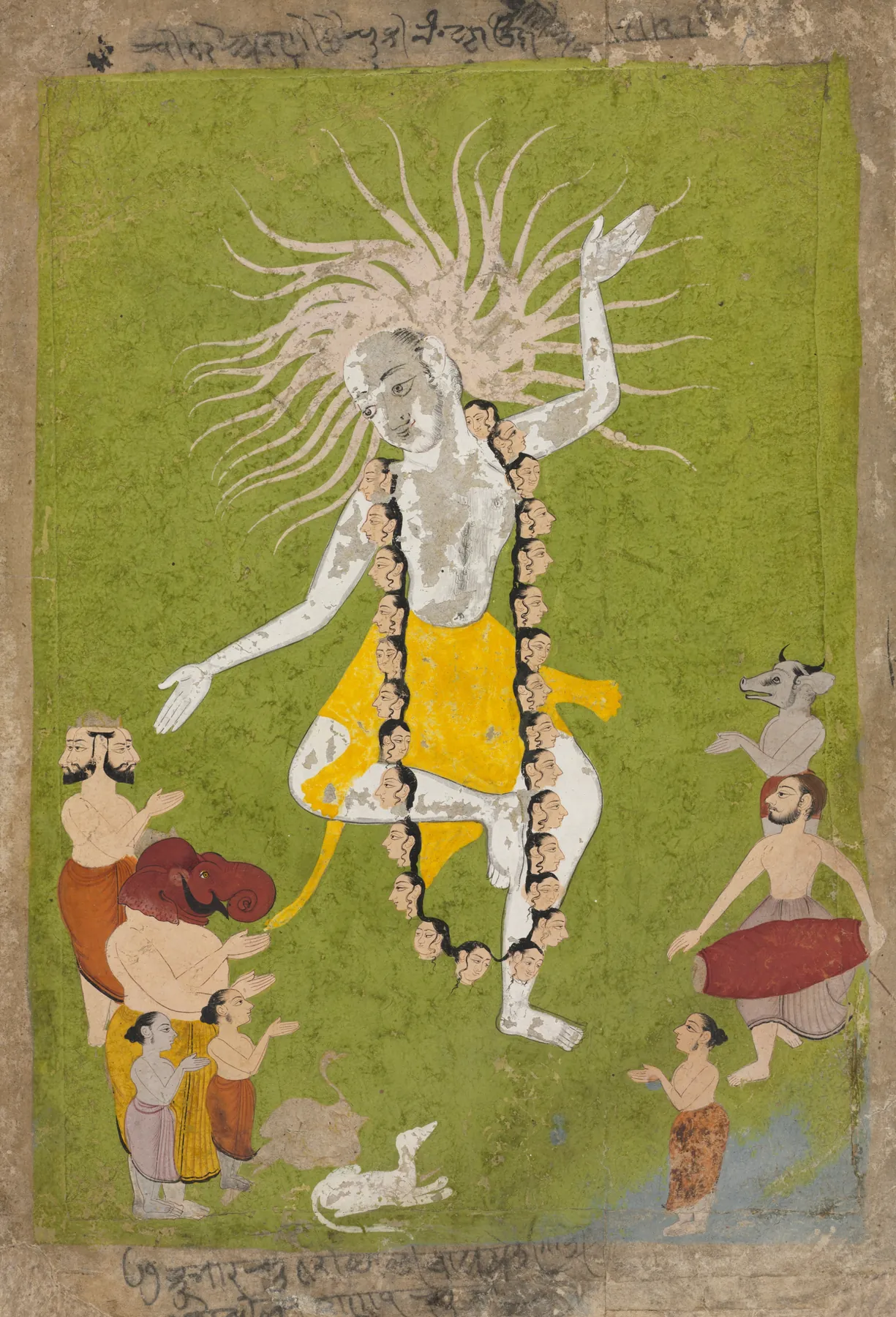
God Shiva in His Ferocious Aspect as Mahakala Dancing. Northwestern India, Rajasthan, Rajput Kingdom of Mewar, c. 1700–1710.
God Shiva in His Ferocious Aspect as Mahakala Dancing, c. 1700–1710

Four Marks

त्रिनेत्र

Trinetra · The Third Eye

The two horizontal eyes divide everything they meet: near and far, gain and loss, mine and yours.

The third eye stands vertical, at the midpoint where opposites fall silent.

It does not see a hidden object; it stops splitting what is already here.

डमरु

Ḍamaru · The Hourglass Drum

Two opposing triangles — inhale and exhale, arising and passing — meet at one narrow waist.

Sound, time and thought strike the two wide faces.

At the waist between them sits the silent zero-point from which every beat is born.

विभूति

Vibhūti · Sacred Ash

Wood becomes smoke, charcoal and flame — everything that can still change.

Once burned all the way to white ash, fire cannot burn it a second time.

Ash is the mark of what remains when every borrowed name has fallen away.

नटराज

Naṭarāja · The Dancer in Fire

Inside the ring of flame, the limbs whirl through creation and dissolution.

Look at the face in any Chola bronze: utterly unhurried, utterly still.

Beneath the planted foot lies Apasmāra — only one demon: forgetting who you are.

Four Fearless Voices

Translation · 1920 (Grierson & Barnett)

Lallā (Lal Dĕd)

c. 1320–1392 CE · Kashmir

Lord, I have not known myself or other than myself.

Continually have I mortified this vile body.

That Thou art I, that I am Thou, that these are joined in one I knew not.

It is doubt to say, ‘Who am I?’ and ‘Who art Thou?’

For years she punished her own body searching for a distant Lord, until the split between seeker and sought gave way. Even the question ‘Who art Thou?’ turns out to keep two where there was only one.

Lallā-Vākyāni, saying 7, pp. 29–30 (Royal Asiatic Society, 1920) · Source ↗

Sanskrit refrain (sa.wikisource) + Living Mystics gloss

Ādi Śaṅkara

8th century CE · Nirvāṇa Ṣaṭkam

चिदानन्दरूपः शिवोऽहं शिवोऽहम् ॥

cidānanda-rūpaḥ śivo 'haṃ śivo 'ham ||

Pure consciousness and bliss — I am Shiva, I am Shiva.

Verse by verse he drops every object you can point to — mind, ego, memory, senses, elements, birth, death, even the race to be liberated. What stays after every ‘not this’ is not a void, but the witness itself.

Nirvāṇa Ṣaṭkam (Ātma Ṣaṭkam), refrain (Sanskrit Wikisource) · Source ↗

Editorial portrait · Kannada Vacana lineage

Akka Mahādevi

12th century CE · Karnataka

In twelfth-century Karnataka, Akka Mahādevi walked out of a royal palace wearing only her long hair, refusing every veil and status polite society asked her to keep. Speaking to Shiva as Cenna Mallikārjuna — Lord White as Jasmine — she sang that once you make your home on the mountain or the open sea, neither wild beasts nor waves nor praise nor insult can touch you.

12th-century Kannada Vīraśaiva Vacana tradition (modern English translations remain under copyright and are not quoted here)

Short quote · Nān Yār (tr. T. M. P. Mahadevan)

Sri Ramana Maharshi

1879–1950 · Arunachala

After negating all of the above-mentioned as ‘not this’, ‘not this’, that Awareness which alone remains — that I am.

At the foot of Arunachala — honoured in the Śiva Purāṇa as Shiva standing as a silent mountain of fire — Ramana brought inquiry down to one clean turn: when a thought or storm rises, to whom does it arise? Follow the ‘I’ back until only awareness remains.

Ramana Maharshi, Nān Yār (Who Am I?), Q&A 2, tr. T. M. P. Mahadevan (Sri Ramanasramam) · Source ↗

The six worlds
  1. शिव लोकShiva Lok
  2. कृष्ण लोकKrishna Lok
  3. भक्ति लोकDevotion Lok
  4. बुद्ध लोकBuddha Lok
  5. ज़ेन लोकZen Lok
  6. कृष्णमूर्ति लोकKrishnamurti Lok
  7. यात्राThe Universal Walk
Look closer